Pigment closed a $250 million Series E at a $2.3 billion valuation in October 2026, with Nvidia, Iconiq, and IVP joining the round (Sifted, 2026). That kind of backing tells you the platform isn't going anywhere. But raising money and getting a finance team live on connected planning software are two different problems, and the gap between them is usually the implementation partner.
Picking the wrong one doesn't just slow a project down. It can leave a finance team back where it started: reconciling spreadsheets at 11pm before a board meeting. This guide walks through what actually separates a strong Pigment implementation partner from a weak one, what the process typically looks like, and the questions worth asking before you sign anything.
TL;DR: A good Pigment implementation partner brings certified configuration experience, real ERP/data integration capability, and a defined post-go-live support model, not just software know-how. With 82% of finance teams already juggling four or more disconnected data tools (insightsoftware, Dec 2025), the partner's integration depth often matters more than their sales pitch.
What Does a Good Pigment Implementation Partner Actually Look Like?
The strongest signal isn't a logo on a partner page, it's whether the team can show you a data model they've built, not just a demo they've clicked through. A partner who can walk through how they'd structure your hierarchies, your currency handling, and your actuals feed before you've even signed is telling you something real about how they'll handle the harder parts later.
Four things tend to separate capable partners from ones who are learning on your dime:
Certified, hands-on configuration experience. Not just "we've seen Pigment," but consultants who've built models in it, broken things, and fixed them.
Integration depth with your existing stack. ERP systems, data warehouses, HR platforms, whatever feeds your numbers. A partner who can only talk about the planning layer and gets vague about integration is a partner who'll hand that problem back to you mid-project.
Industry-specific deployment experience. A SaaS company's revenue model and a manufacturer's supply planning model aren't the same problem. Ask for an example close to your own.
A defined post-go-live support model. What happens in month two, when the initial excitement fades and someone on your team hits an edge case the demo never covered?

A consultant reviewing business data with a client during a planning engagement.
For a broader look at what "good" looks like across connected planning platforms generally, not just Pigment, our Anaplan consulting partner buyer's checklist covers a lot of the same evaluation ground, since the underlying questions (certification, integration, support) carry across platforms even when the tools themselves don't.
Why Does Data Integration Matter So Much in a Pigment Implementation?
Eighty-two percent of finance teams now use four or more separate tools just to manage their data (insightsoftware, Finance Under Pressure, Dec 2025), and the same report names data accuracy as one of the two biggest planning and budgeting challenges finance leaders face, right behind market uncertainty. A planning platform is only as good as what feeds it. If your implementation partner treats integration as an afterthought, you'll inherit that problem permanently.
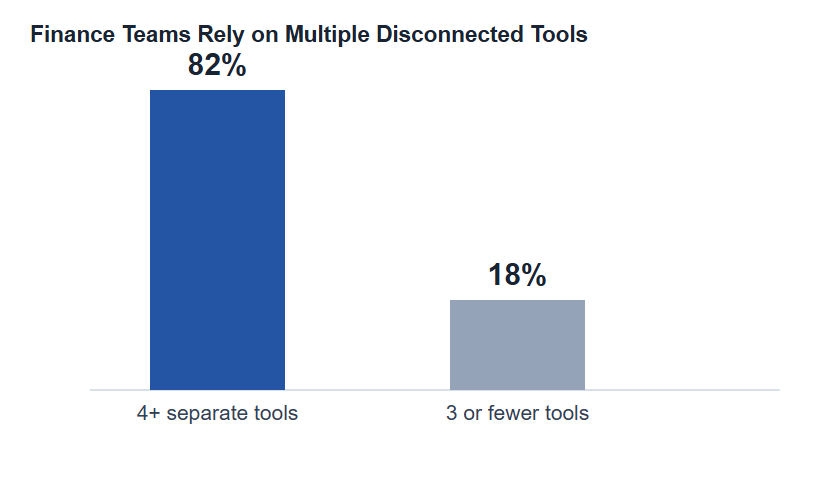
Source: insightsoftware, Finance Under Pressure report, December 2025
A capable partner will ask about your chart of accounts, your ERP's API limitations, and how often your master data changes before they ask what colors you want on your dashboards. That ordering matters. The integration conversation usually reveals more about a partner's real experience than their sales deck does, because it's the part that's hardest to fake.
GenXAI's own Pigment implementation practice builds implementations around exactly this principle: the data model and integration layer get designed before a single dashboard gets built, not after.
What Does the Pigment Implementation Process Typically Involve?
Most Pigment implementations move through five recognizable phases: discovery and data modeling, configuration, integration build, user acceptance testing, and go-live, followed by a hypercare period. Skipping or rushing any of these is where projects start to slip. A Gearset-commissioned survey of 200 enterprise IT decision-makers found UK software deployments ran an average of four months behind schedule, affecting more than eight in ten businesses surveyed (Gearset, State of Salesforce DevOps Report, 2025).
Here's roughly what each phase involves:
Discovery and data modeling. Your partner maps your planning hierarchies, dimensions, and calculation logic. This is where most of the real thinking happens, even though it produces the least visible output.
Configuration. The platform gets built out against that model, workflows, approval chains, and reporting views included.
Integration build. Connections to your ERP, data warehouse, or HR system get built and tested. This is usually the phase that reveals whether a partner's integration claims were real.
User acceptance testing. Your actual users, not just the project team, try to break it. This phase is uncomfortable and necessary.
Go-live and hypercare. The platform goes live, and the partner stays close for a defined window afterward, not just a one-week check-in, to catch the issues that only show up under real usage.
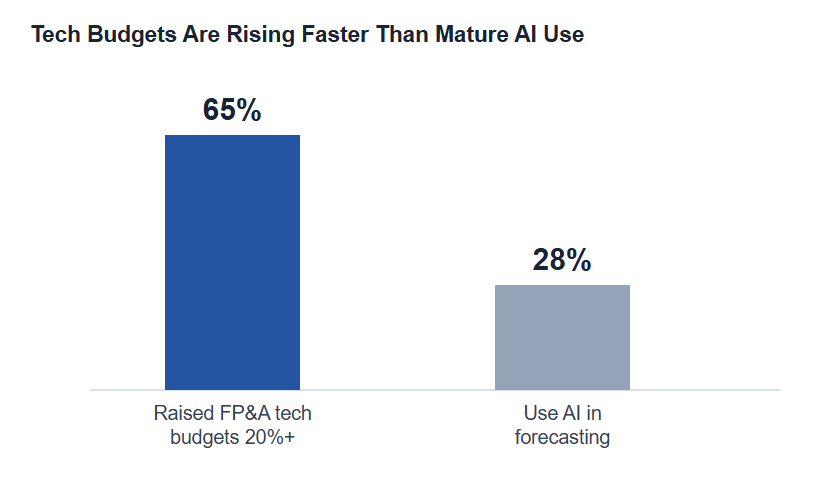
Source: Limelight, 2026 FP&A Trends Report
That gap between budget and maturity is worth sitting with for a second. Finance leaders are spending more, but most organizations are still early in turning that spend into working, trusted automation. A realistic implementation partner will tell you upfront which phase of that maturity curve you're actually starting from, rather than promising day-one AI-powered forecasting when your data foundation isn't ready for it yet.
What Are the Red Flags When Vetting a Pigment Implementation Partner?
A few patterns show up consistently among implementations that struggle, and most of them are visible before the contract is signed. None of these are about any particular platform being hard to implement. They're about how a partner approaches the work.
Vague answers about integration. If a partner can't describe, specifically, how they'll pull data from your ERP, that's a conversation to have before signing, not after.
No post-go-live plan. Ask directly: what happens in week six? A partner without a clear answer is a partner who considers go-live the finish line instead of the start.
Generic industry claims. "We've worked across industries" is not the same as "we've built a model for a company with your specific planning complexity." Ask for the difference.
Timeline estimates with no caveats. Real projects hit real complexity. A partner who promises a fixed timeline with no discussion of dependencies either hasn't done this before or isn't being straight with you.
Reluctance to involve your actual users early. If UAT gets pushed to the final week of the project, that's a sign the partner is optimizing for their own schedule, not your adoption.
In practice, the projects that go smoothly are rarely the ones with the flashiest kickoff deck. They're the ones where the partner asked uncomfortable questions about your data quality in week one, instead of discovering those problems in week eight.

Close-up of financial charts and analysis documents on a desk, representing the detail-level review involved in evaluating a planning platform implementation.
Why Does AI Adoption in FP&A Matter for Your Partner Choice?
Forty-seven percent of FP&A teams now use AI in at least one workflow, up from just 6% in 2024 (EY-sponsored FP&A Trends study, 2025). That's a real shift, not a marketing talking point, and it changes what you should expect from an implementation partner. A partner who only knows how to configure static reports and manual workflows is building you a platform for where finance was two years ago.
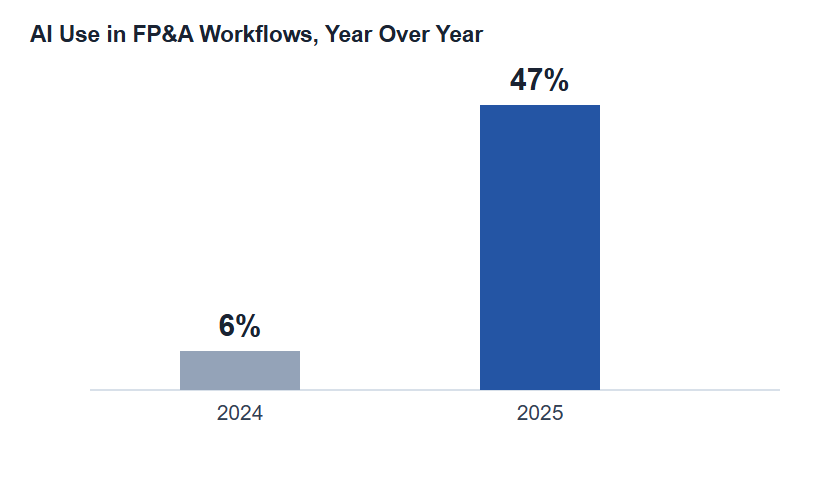
Source: EY-sponsored FP&A Trends study, 2025
That doesn't mean every implementation needs AI-driven forecasting on day one. It means your partner should understand how the platform's AI-assisted capabilities fit into your roadmap, even if you're starting with core planning and adding that layer later. Ask what that path looks like concretely, not as a future promise with no specifics attached.

Business professional analyzing growth and planning data, reflecting the forward-looking work finance teams take on after a successful implementation.
How Should You Weigh a Boutique Specialist Against a Larger Firm?
There's no universally right answer here, and anyone who tells you otherwise is probably trying to sell you something. What matters is matching the partner's structure to your project's actual shape. A smaller, specialized team often means the people who scope your project are the same people who build it, which can mean fewer handoffs and faster decisions. A larger firm may bring more bench depth if your rollout spans multiple regions or business units at once.
Ask directly who will actually be doing the work, not just who's in the sales meeting, and how much of that team's time is dedicated versus split across other active projects. The size of the firm matters less than the size of your actual team's attention.
Frequently Asked Questions
How long does a typical Pigment implementation take?
Timelines vary with scope and data complexity, so treat any fixed number with caution. What's measurable: enterprise software deployments broadly ran an average of four months behind initial schedules in one 2025 UK study (Gearset, 2025), which is a good reason to ask your partner how they build buffer into their timeline rather than accepting an optimistic headline number.
Do I need a certified Pigment partner, or can any consultant configure it?
A certification signals that consultants have been trained and vetted on the platform directly, but it's not a substitute for asking to see actual configuration work. The strongest evaluation combines certification status with a real walkthrough of past data models, not one or the other alone.
What's the difference between Pigment implementation services and ongoing support?
Implementation services cover the initial build: data modeling, configuration, integration, and go-live. Ongoing support covers what happens afterward, new workflows, model adjustments as your business changes, and troubleshooting. Ask whether these are bundled or separate before you sign, since the gap between them is where projects often lose momentum.
How does Pigment implementation compare to other connected planning platforms?
Each platform has its own data model, integration approach, and configuration logic, so the specific implementation steps differ by tool. For a closer look at evaluating partners for Anaplan specifically, see our Anaplan consulting partner buyer's checklist.
What questions should I ask before signing with a Pigment implementation partner?
Ask for a specific example of a data model they've built, how they handle ERP integration technically (not just conceptually), what their post-go-live support model includes and for how long, and who on their team will actually staff your project. Vague answers to any of these are worth probing further before you commit.
Key Takeaways
A strong Pigment implementation partner shows you real configuration experience, not just a sales pitch, and can speak concretely about integrating with your ERP and existing data sources.
With 82% of finance teams already managing four or more disconnected tools, integration depth matters as much as platform expertise.
A defined, time-bound post-go-live support model separates partners who finish projects from partners who finish contracts.
AI adoption in FP&A nearly doubled between 2024 and 2025, so ask how your partner's roadmap accounts for that shift, even if you're not using it on day one.
Boutique and larger firms both work, the right fit depends on who actually staffs your project and how much of their attention you'll have.
If you're evaluating partners for a Pigment rollout, GenXAI's Pigment implementation services build connected planning implementations around the data and integration work first, the part that determines whether the rest of the project holds up. And if Anaplan is also on your shortlist alongside Pigment, our Anaplan buyer's checklist walks through the same evaluation questions from that angle.