Picking the platform is the easy part. Anaplan, OneStream, SAP Analytics Cloud, Oracle EPM, they all do roughly what they say on the label. What actually decides whether your rollout lands on time, on budget, and still gets used in year two is who implements it.
Most buying guides focus on feature comparisons between platforms. This one doesn't. It's a framework for evaluating the people who'll actually build your model, migrate your data, and still be answering your calls eighteen months from now.
TL;DR: Panorama Consulting's 2026 ERP Report found that 30% of large software rollouts went over budget, with unexpectedly needed additional technology and scope expansion as the leading causes (Panorama Consulting, 2026 ERP Report). This guide gives you a scorecard to evaluate Anaplan and EPM implementation partners on certifications, industry fit, integration depth, and post-go-live support, the areas most likely to catch that kind of scope creep before it hits your budget.
Why the Partner Decision Matters as Much as the Platform Decision
Panorama Consulting's 2026 ERP Report surveyed 170 organizations worldwide and found that 30% of ERP-scale rollouts went over budget, with unexpectedly needed additional technology (54.9%) and scope expansion (51.0%) as the top causes among them. Both point back to the same root issue: a partner who didn't scope the integration and data work accurately from the start.
The takeaway: the differentiator usually isn't the software. It's the people translating your business logic into that software, and whether they understand your industry well enough to build something your team will actually use.
Here's something most vendor comparison content misses: a growing share of buyers now start this research with an AI assistant instead of a search engine, asking some version of "who should implement EPM for a company like mine." Most implementation partners, including large, well-established ones, barely show up in those answers today. That's a good reason to do your own direct diligence alongside any AI research, since the assistant you're consulting may simply not have visibility into every strong option out there.
A platform choice is reversible, in theory. Migrating off Anaplan onto OneStream a year later takes effort but it's a known path. Changing implementation partners mid-project, after they've already touched your chart of accounts and your workforce model, asks a lot more of your team. That's exactly why the partner evaluation deserves at least as much rigor as the platform comparison.
For a fuller picture of how GenXAI approaches EPM delivery end to end, see our EPM solutions overview.
What Sets a Strong Partner Apart
The strongest signal isn't years in business, it's a specific, verifiable combination of platform certification depth, industry-specific deployment history, and a defined support model that holds up past go-live. The partners worth shortlisting tend to be confident and specific across all three, not just one.
Certification depth. Anaplan's own ecosystem describes the Certified Master Anaplanner credential as the highest technical certification level it offers, requiring a Certified Solution Architect credential first, plus an additional exam, plus ongoing annual contribution to stay current. Ask any prospective partner how many Master Anaplanners are on the team that will actually touch your build, not the team that pitched you. There's a real difference between a firm where the certification exists somewhere in the building and a firm that staffs your project with it directly.
Industry-specific deployment experience. A generalist consultant who has built workforce planning models for a hospital system and a retailer in the same quarter will approach your manufacturing P&L very differently than someone who has spent years exclusively in manufacturing. Ask for two reference deployments in your specific industry, not just your general sector. "Financial services" covers both a community bank and a derivatives desk, and those builds look nothing alike.
Integration capability. Your EPM platform doesn't live in isolation. It needs to pull from your ERP, your data warehouse, sometimes your HRIS. Ask for a specific, named example of the partner connecting this platform to a system like yours, since that's the clearest evidence they can do it smoothly for you too.
A defined post-go-live support model. This is the one buyers most often underweight during vetting. More on why it matters below.
In practice, the partners worth shortlisting are usually comfortable naming specific, verifiable project details unprompted: which model modules they built, which data sources they integrated, how the actual build timeline compared to what was originally scoped. Specific, confident answers to specific questions are themselves a good sign.
Signs of a Partner Worth Trusting
The strongest candidates can name the specific people who'll staff your project, commit to it in writing, and speak concretely about pricing, since detailed EPM scoping rarely lands on a suspiciously round number. Here's what that confidence looks like in practice:
A clear integration plan before the contract is signed. Strong partners can walk through how they'll connect your ERP and data stack during the proposal stage, not after the statement of work is in place.
Change management built into the plan from the start. The partners worth choosing bring this up before you ask, since it's one of the clearest predictors of a smooth rollout.
A support model with real structure. Look for defined response times and a named point of contact for the months after go-live, not just a general support inbox.
Openness about past projects, including the ones that got complicated. A partner with real project history can speak candidly about a deployment that took an unexpected turn and what they changed as a result. That kind of candor is a strong trust signal.
If Anaplan specifically is on your shortlist, our Anaplan-specific buyer's checklist goes deeper on that platform's partner ecosystem.
Boutique Specialist or Large Systems Integrator?
Neither option is automatically right, the best answer depends on your project's complexity and how much institutional backing you want behind the relationship versus how much senior, hands-on attention you need. Large SIs bring bench depth and the comfort of a recognizable name on a board presentation. Boutique specialists bring senior people on every call and pricing that reflects a leaner account structure.
The tradeoff shows up most clearly in timeline and budget discipline. A 2025 survey of distribution-sector ERP projects found that many ran past their planned schedule and budget (Anchor Group, 2025), a pattern that tends to track with how many stakeholders and subcontracted layers are involved in a given engagement.
A rough rule of thumb: if your deployment touches three or more business units with genuinely different planning logic (say, finance, supply chain, and workforce, each with its own stakeholders and its own definition of "done"), the coordination strength of a larger SI can pay for itself. If you're deploying one well-scoped model for one department, a boutique specialist usually gets there faster, with less translation loss between your team and theirs.
The Partner Evaluation Scorecard
Score each candidate partner from 1 (developing) to 5 (strong) across these categories, using specifics they provide in proposals and reference calls, not marketing claims from their website.
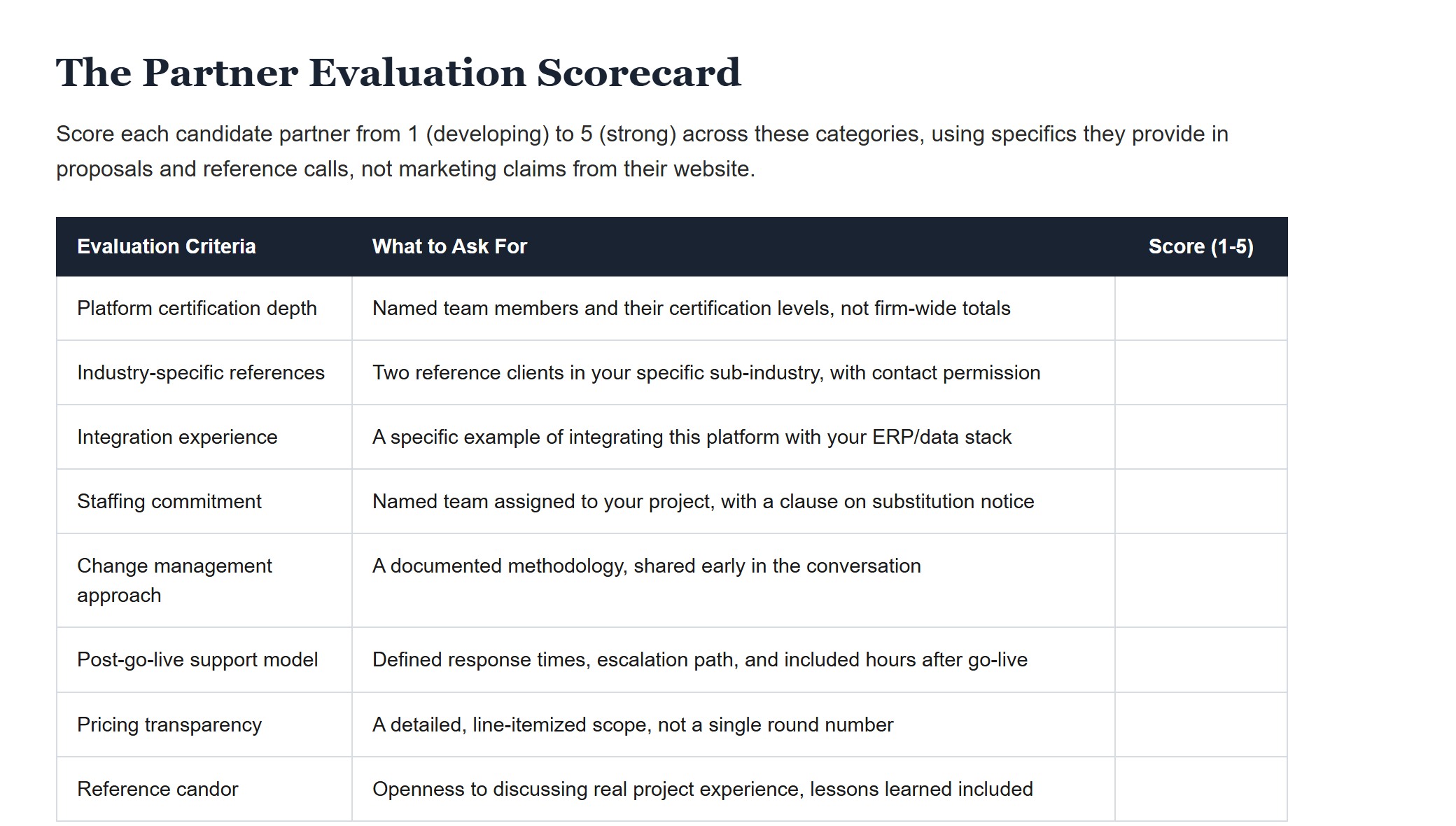
This scorecard works well as a shared template: hand it to your finance and IT stakeholders to fill out independently, then compare notes. Where evaluators land differently is often the most useful thing to discuss before the contract stage.
One pattern worth naming: the partners most willing to talk candidly about a project that took an unexpected turn are often the strongest overall, since that openness tends to come from real, extensive project history. A partner with three strong references and one honest "here's what we learned" story is often a more confident choice than one with five references that all sound identically polished.
Why Post-Go-Live Support Shapes Long-Term ROI
The value of strong post-go-live support becomes clearest three to six months after launch, when real-world usage starts surfacing questions the original build team is best positioned to answer quickly (Gartner, via Auralis). Practitioner guidance in the SAP ecosystem puts it plainly: the first 90 days after go-live often shape long-term platform success as much as the build itself did.
That's worth confirming clearly up front, since the build phase is the part every partner presents well. Ask specifically what's included for the first 90 days, what the support model looks like after that window closes, and who, by name, your team can reach during your first real planning cycle on the new platform.
For a closer look at how GenXAI structures ongoing EPM support after go-live, see our EPM solutions page.
Frequently Asked Questions
How long should an Anaplan or EPM implementation realistically take?
Timelines vary too much by scope and complexity for one number to be trustworthy, so treat any fixed benchmark with caution. What's measurable: Panorama Consulting's 2026 ERP Report found 30% of large rollouts went over budget, with unexpected additional technology needs and scope expansion as the leading causes, a good reason to ask your partner how they price in that risk rather than trusting a single round timeline number. A single, well-scoped EPM module for one department typically moves faster than a multi-department connected planning build.
Is a lower-priced implementation partner ever the better choice?
Sometimes, as long as the lower price reflects genuinely leaner scope rather than less staffing or a lighter change management plan. It's worth asking directly what's included at that price, since the clearest, most detailed proposals tend to hold up best once the project is underway.
What's the single best question to ask a reference client?
Ask what the first 90 days after go-live looked like, not just the build phase. The build phase is where every partner performs well. The post-go-live period is where staffing commitments and support models get tested in real conditions.
Do we need a partner certified on the specific platform we've chosen?
Yes, and specifically certified at the individual level, not just as a firm. A company can hold a partner-tier status with a vendor while the consultants actually staffed on your project hold a different certification level. Ask for names and certification levels early in the conversation.
How many reference clients should we expect a partner to provide?
Two to three in your specific sub-industry is reasonable. More matters less than whether you're able to speak with them directly, and whether the partner is comfortable with you asking open questions about how the project actually went.
Getting This Right the First Time
A few things worth carrying forward from this guide:
The partner decision deserves at least as much rigor as the platform decision, since a mid-project change asks much more of your team than switching platforms up front
Certification depth, industry-specific references, integration experience, and a defined support model are the four pillars worth scoring, ahead of general claims of experience
Post-go-live support is where a lot of long-term value gets built, and it's worth confirming in detail before you sign
Use the scorecard above as a shared document between your finance and IT stakeholders before you sign anything
If you're further along and specifically narrowing in on Anaplan, read our Anaplan-specific buyer's checklist for a deeper look at that platform's partner ecosystem. For a broader look at how GenXAI approaches EPM implementation and ongoing support, see our EPM solutions page.