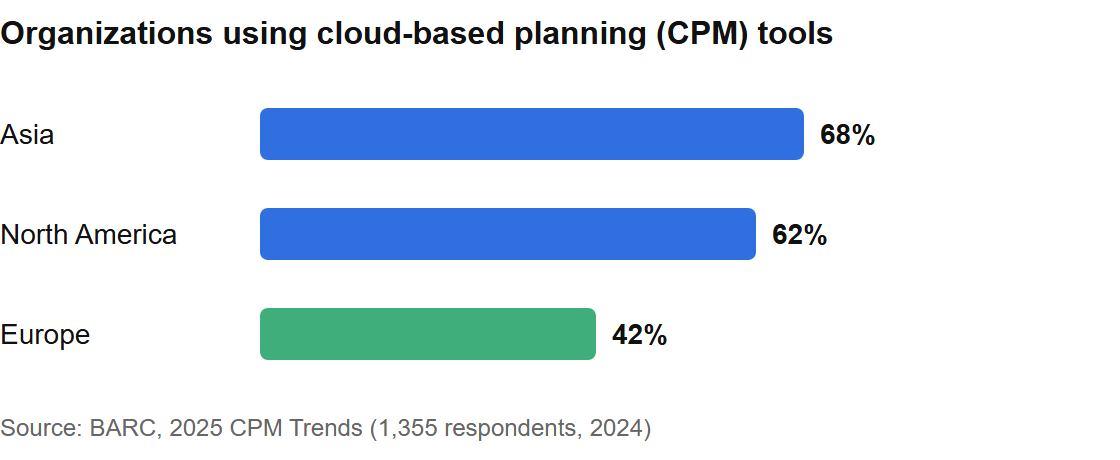
Two finance teams can sign for the same EPM platform and still expect very different projects. In North America, 62% of organizations already run planning in the cloud. In Europe, it's 42% (BARC, 2024). That 20-point gap says a lot about the questions each buyer asks first.
This guide covers what US and European finance teams prioritize, the rules behind those priorities, and how to build one planning model that works in both regions. If you're new to the topic, start with our guide to what enterprise performance management is.
TL;DR: US and European finance teams buy EPM for different reasons. BARC's CPM Trend Monitor 2026 found North America focuses on cloud and risk management, while Europe focuses on ESG reporting and scenario planning. Companies planning across both regions need one shared model with regional layers for accounting standards, data rules and sustainability reporting.
What Do US Finance Teams Want From an EPM Rollout?
North American organizations put cloud solutions and risk management at the top of their planning agenda, according to BARC's CPM Trend Monitor 2026, a survey of 989 business and IT professionals (BARC, 2025). With most already on cloud planning, US buyers rarely debate the move. They ask how fast they can build on it.
That shapes the first conversation. US teams usually arrive with three expectations:
Cloud by default. The question is which processes move first, not whether to move.
Risk visibility. Leaders want forecasts that show the downside quickly when costs, demand or rates change.
One reporting standard. US domestic public companies must report under US GAAP (SEC), which keeps the reporting side of the model simpler.
Sustainability reporting is a smaller factor for now. The SEC's 2024 climate rule is stayed, and the agency has proposed rescinding it (Jones Day, 2026). The exception is California. Under SB 253, US companies with over $1 billion in revenue doing business in California must report Scope 1 and 2 emissions, with the first deadline targeted for November 10, 2026.
For a closer look at risk-ready forecasting in practice, see how Anaplan turns the annual budget into a rolling forecast.
What Do European Finance Teams Want From an EPM Rollout?
European organizations put more weight on ESG reporting and scenario planning, BARC found (BARC, 2025). Only 42% use cloud planning tools, compared with 62% in North America and 68% in Asia (BARC, 2024). So European projects often start with data, controls, and reporting rules before features.
Three requirements tend to shape European rollouts.
IFRS alongside local GAAP
Since 2005, EU companies listed on a regulated market must prepare consolidated statements under IFRS as adopted by the EU (European Commission). Local entities may still report under national rules. The planning model has to map both without duplicate work.
Data residency and GDPR
Workforce planning holds salaries and personal data, and GDPR sets rules for moving that data outside the EU. The EU-US Data Privacy Framework was upheld by the EU General Court on September 3, 2025, but an appeal was filed that October (National Law Review, 2025). Many European teams want to know exactly where workforce planning data sits before they sign.
Sustainability reporting for large companies
The EU's Omnibus I Directive narrowed CSRD to companies with more than 1,000 employees and over €450 million in net turnover, applying from financial years starting January 1, 2027 (Latham & Watkins, 2026). Fewer companies are in scope, but those that are need ESG figures reported next to their financials.
How Does Region Change the Way a Rollout Is Planned?
A third of companies (33%) now say integrating financial and operational planning is a priority (BARC, 2024). Teams on both sides of the Atlantic want that. What differs is what has to be right on day one.
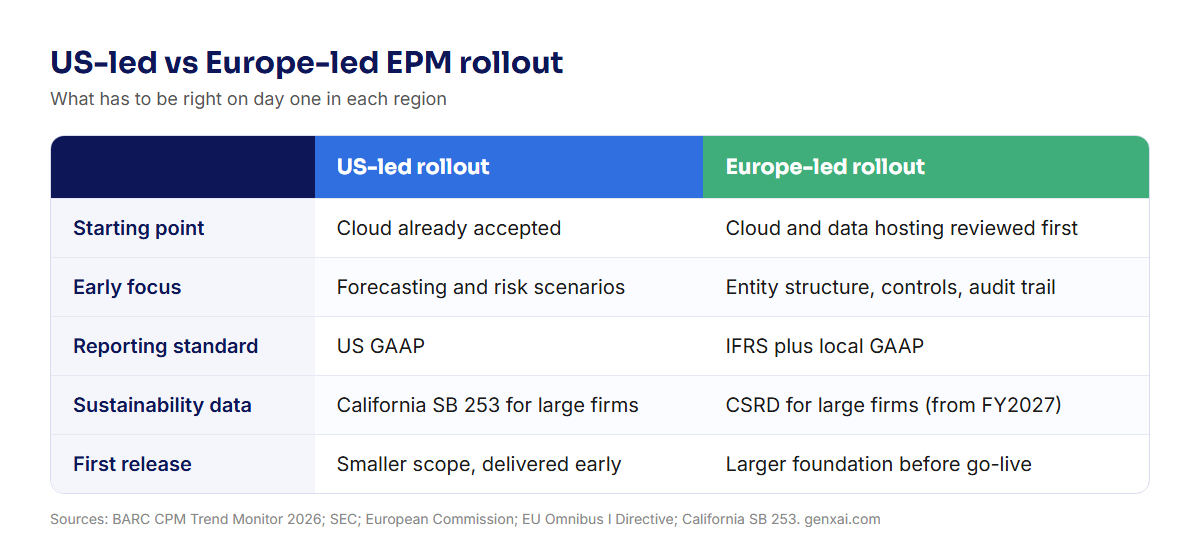
In our view, the regional difference is mostly about sequence, not scope. A US project and a European project often end up with similar models. They just build the pieces in a different order. Is your rollout plan built for the region that has the strictest day-one requirements?
How Do You Build One Planning Model for Both Regions?
More than half of organizations (53%) plan to adopt predictive planning and forecasting (BARC, 2024). That only works across regions if everyone plans on the same base. Here's the approach we recommend:
Agree on a shared core. One chart of accounts, entity hierarchy, currency logic and planning calendar.
Add regional layers. Map US GAAP, IFRS and local GAAP views on top of the core, not in separate models.
Decide data hosting early. Settle where personal and workforce data will sit before design starts.
Size ESG data to the rules. Build sustainability modules only for the entities that must report.
Phase the go-live. Release the core where requirements are lighter, then add entities as mappings and data rules are signed off.
Picking the right delivery partner matters as much as the model design. Our Anaplan consulting partner checklist covers the questions to ask.
Frequently Asked Questions
Can European companies use cloud EPM under GDPR?
Yes. GDPR doesn't ban cloud planning. It sets rules for moving personal data outside the EU. Transfers to certified US providers can rely on the EU-US Data Privacy Framework, which the EU General Court upheld on September 3, 2025. An appeal is pending, so many teams also review where data is hosted.
Does CSRD apply to US companies?
It can. Under the Omnibus I changes, non-EU groups fall in scope if their EU net turnover exceeds €450 million and an EU subsidiary or branch generates more than €200 million (Latham & Watkins, 2026). The new scope applies from 2027 financial years.
Which accounting standard should a multi-region planning model use?
Usually more than one. US public companies report under US GAAP, while EU-listed groups have used IFRS for consolidated statements since 2005. A shared model with regional reporting layers lets finance teams plan once and report in each required standard. See our financial close and consolidation services.
Key Takeaways
North American teams focus on cloud and risk management. European teams focus on ESG reporting and scenario planning (BARC, 2025).
Cloud planning use is 62% in North America and 42% in Europe (BARC, 2024).
European rollouts must plan for IFRS, local GAAP, GDPR, and, for large companies, CSRD.
Multi-region companies do best with one shared core and regional layers on top.
GenXAI's EPM team designs and delivers planning models on Anaplan, CCH Tagetik, Workday and Pigment, and was named Anaplan Partner of the Year (2016) and Anaplan Growth Partner of the Year (2022). If you're planning a rollout across regions, talk to our EPM team.